Now here (2014)
HDV, color, 16:9, 24 min, USA 2914, re-edited NL 2024, camera’s: Yukako Ando, Caro Neffgen, co-production Anke Schäfer with Art Stichting Smokkel and LACC-Living Arts Counseling Center
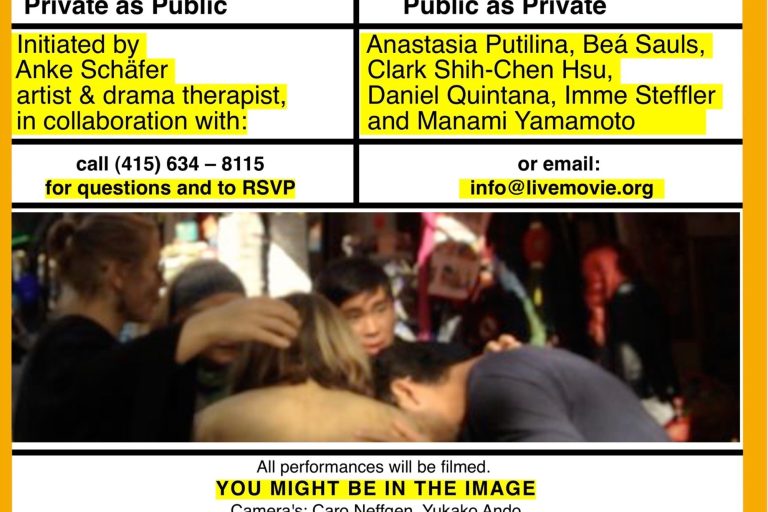
Video essay of the eponymous eight-hour performance at five sites in San Francisco with colonial and police violence connotations on December 3, 2014.
During the performance, a small group of performers led visitors to five different locations throughout San Francisco. These locations held biographical significance for some of the performers and contained visible and invisible traces of violence experienced through generations.
The performers had previously participated in an eight-session drama therapy workshop on embodied transgenerational legacies led by Anke Schäfer. They researched possible embodied traces of violence or disintegration through embodied sculptures and scenic improvisation.
This video explores the limits of documenting embodied violence and embraces the ambiguous performative echoes of transgenerational trauma as a form of bodily rebellion against oppression and silencing.
I am wall – I am floor (2011)
HDV, color, mono, 12 min., concept, editor, camera: Anke Schäfer, photos: Marie-Julia Bollansée, co-creation and co-production Anke Schäfer with Bea Matthys Crepain, NL / B 2011
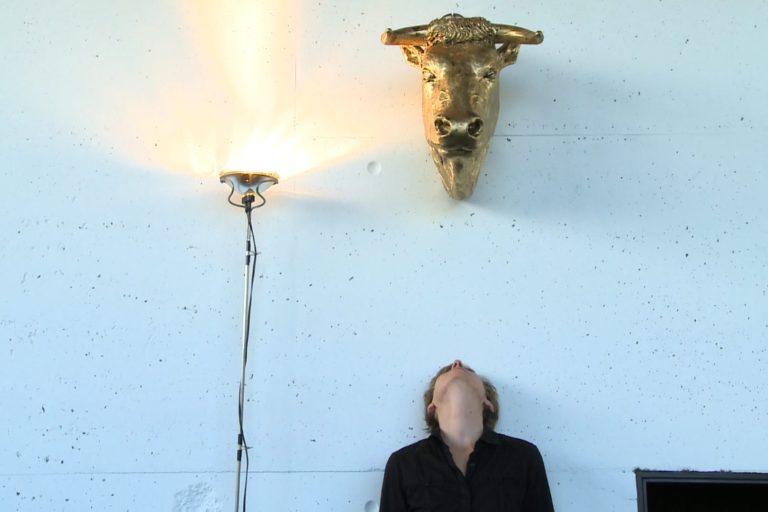
I AM WALL – I AM FLOOR is a video work of a performance of the same name that took place in the home of art collector Bea Matthys Crepain. The house was designed by her late husband, the renowned Belgian architect Jo Crepain.
The audience were made up of people who regularly attended art events organized by Bea.
Over the course of five days, the artist had studied Bea's daily movements in her house by mirroring, slowing down, and rendering them. Then, the artist invited Bea to do the same.
The final performance was co-created in reference to these daily studies.
This video consists of rehearsal recordings by Anke Schäfer and photographic documentation of the performance by Marie Julia Bollansée.
Edited as a journey through a private space in search of an unknown planet called home, it is a visual exploration of the concept of belonging.
Freestyle Mzungu (2011)
FREESTYLE MZUNGU, HDV, color, 16:9, 20 min , Kenya 2010/2011, re-edited NL 2024; Preview: 2:30 min; with: Gakunju Kaigwa, Dennis Muraguri, Cyrus Ng’ang’ga and Anke Schäfer, co-production Anke Schäfer with Kuona Art Trust Nairobi and the Dutch Mondriaan Foundation (NL)
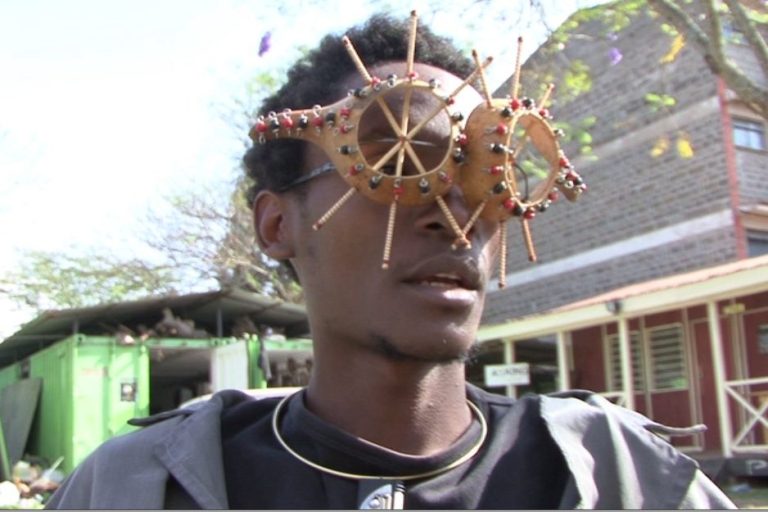
FREESTYLE MZUNGU is a documentation of conversations with three artists at the Kuona Art Trust during an artist residency in Nairobi made possible by the Mondriaan Foundation. The artists discuss the prospects of earning a living in Kenya and the extent to which visiting artists perpetuate colonial tourist movements. Cyrus Ng’ang’a invites filmmaker and guest artist Anke Schäfer to start a church together to get rich. Dennis Muraguri explains the meaning of the word "mzungu" as a synonym for someone who is always traveling to strange places, like missionaries, underlining his point with a gesturing motion of circulating. This concept is further explored with the artist Gakunju Kaigwa.
"Freestyle Mzungu" explores the experience of being an artist-in-residence and the opportunity to transform colonial mentalities into connections.

Move Slowly - to avoid accidents (2011)
Installation with colorful ropes made of secondhand clothes from Europe, bought on the Kibera township market, spanned the entire Kuona Trust building and its gangways, featuring drawings and notes from a workshop with the Kuona Artists, video of a turtle (HDV, loop); installation of ropes together with Kota Otieno, Gallery Kuona Trust, solo, with support of the Kuona Art Trust Nairobi and the Dutch Mondriaan Foundation, Kenya 2011
(Additional text and image will follow)
Happy For No Reason (2010)
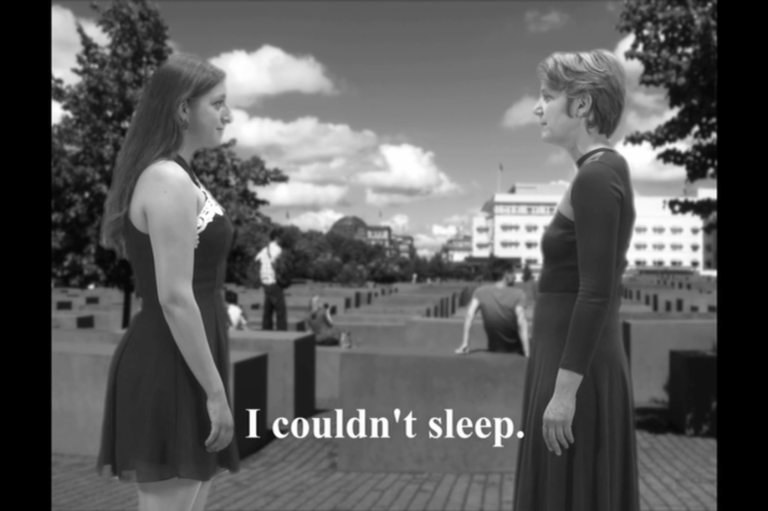
Video Installation, HDV, black-and-white, no sound, subtitles english, format about 4:3, 2:00 min., concept, script, director, editor: Anke Schäfer, performers: Ilil Land-Boss & Anke Schäfer, Risk Hazekamp & Caya Witte, Anja & Birgitta Thaysen, Germany/NL 2010
Commissioned by the Memorial to the Murdered Jews of Europe Foundation, Berlin.
In Queen Christina, Greta Garbo plays a queen who must defend her Swedish empire and act like a man. When she's ready to leave, she has a brief conversation with her chambermaid about dreams and happiness. In the end, she gently takes the chambermaid's head in her hands, kisses her, and says, "How wonderful to be happy for no reason!" Garbo was openly bisexual and had relationships with several women.
This video is a remake of the aforementioned scene featuring diverse female and queer couples.
First, it was nominated for the Memorial to Homosexuals Persecuted Under National Socialism, and then it was commissioned by the Foundation Memorial to the Murdered Jews of Europe in Berlin.
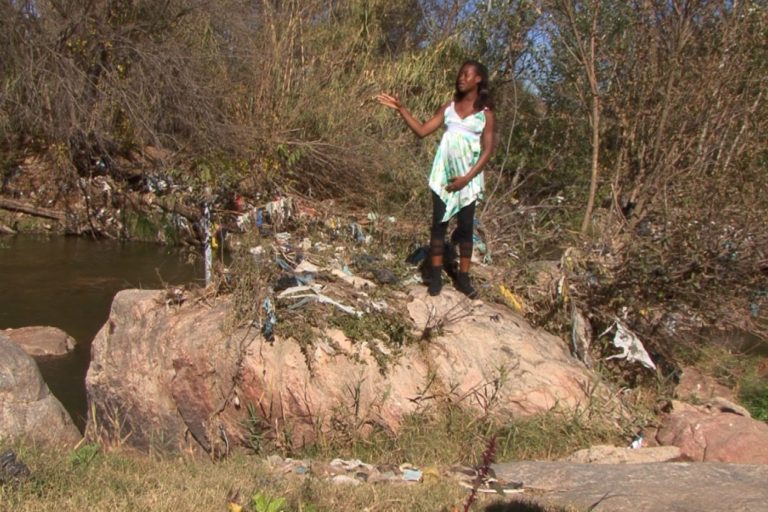
Lorely in Africa (2011)
Video installation or single channel, HDV, 16:9, color, stereo, 12:00 min., Ghana/Namibia/South Africa/ Togo 2010. Concept, director, camera, editing: Anke Schäfer, sound: Shinya Kitamura, protagonists: Collinan, Timo, Naba; co-production Anke Schäfer with the Goethe-Institute Johannesburg, NL 2011
Collinan from the Ivory Coast learnt the song of the Lorely at school. - "Du Swein," says Timo, a German teacher from Lomé, Togo. He knew this German word from his grandmother but had no idea what it meant for a long time. "It means 'pig,'" he translates, adding that there were times when it was not really funny. This was during the time when Togo was a German colony and women like Timo's grandmother were forced to build roads while wearing chains. - Naba, a student from Mali, has a story from her country that sounds very similar to the Lorelei. Traces of the German language and the romantic desire to escape collide with the desire to immigrate to Germany.
The colonial idea of the "savage" is consumed by industrial waste and encourages the idealization of Europe as a better place for those who cannot afford these products. The Lorelei has moved to Africa, slightly disturbed by the polluted rivers.
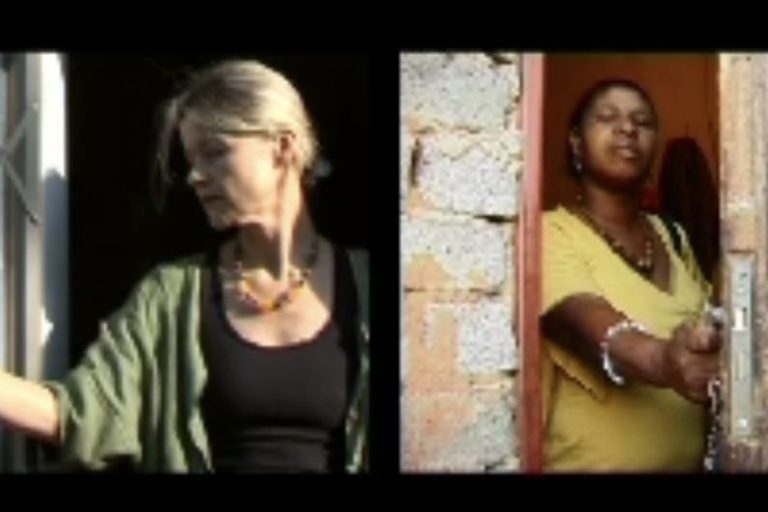
Choreography (2010)
video installation(splitscreen) or single channel, HDV, color, stereo, 13:07 min/loop. Concept, script, director, camera, editor: Anke Schäfer in co-production with the Goethe-Institut Johannesburg, created as part of the exhibition project “Armed Response” South Africa 2008
‘Choreography' reflects the notion of 'armed response' as an inner state of mind. The split-screen projection shows the movement of two women, the German-South African Edda Holl from the wealthy northern suburbs and the African-South African Gloria Fumba from Soweto, both of whom can be followed on their way to work. - Classical continuity editing, as we know it from feature films, suggests a potentially narrative story in the first moment, but is soon interrupted by moments of pause. This pause contains the desire of both women to break with the safety mechanism of their daily movements.
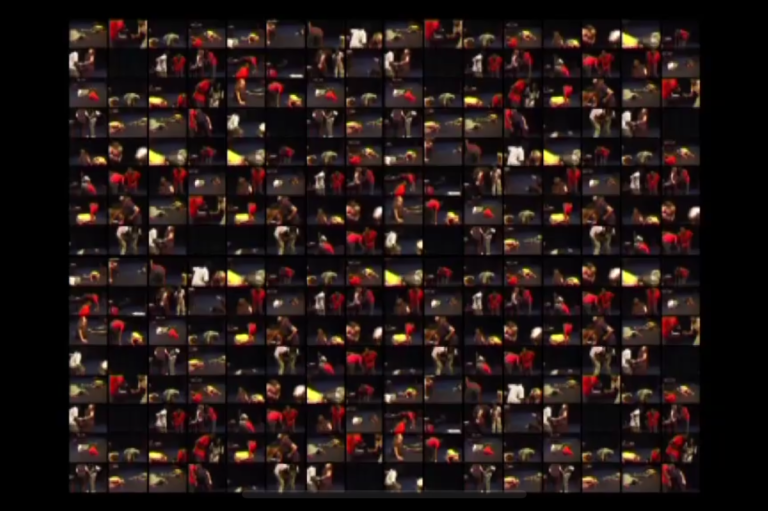
Rehearsal Last Supper - Cacophony (2008)
REHEARSAL LAST SUPPER re-edited as a cacophony for big installation format; 16:9, 16:40 min. loop; concept, editor: Anke Schäfer in cooperation with the EMAF-European Media Festival Osnabrück.
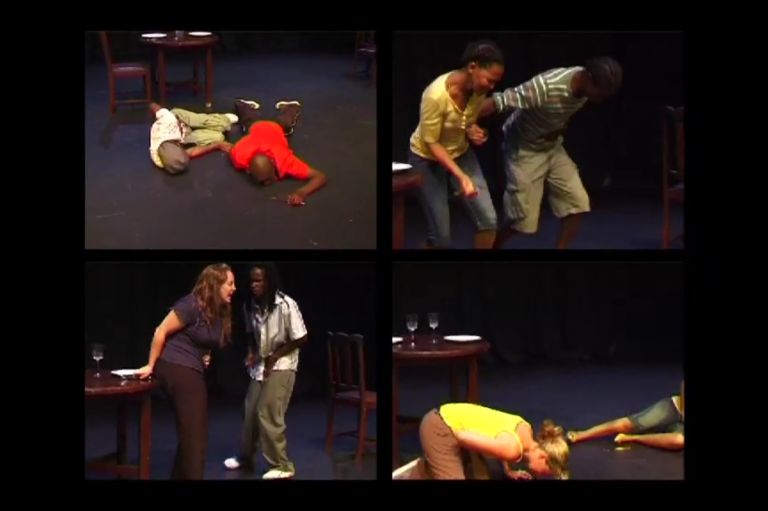
Rehearsal Last Supper (2007)
Rehearsal Last Supper *- video installation(splitscreen) or single channel, HDV, color, stereo, 16:40 min/loop. Script, director, camera, editor: Anke Schäfer in co-production with the Bag Factory Artists Studios Johannesburg, South Africa 2007
The work REHEARSAL LAST SUPPER combines a kind of 'Three Stooges' physical slapstick comedy with far more serious themes of abuse, gender violence and the general breakdown of family relationships. It's a re-enactment of a similar scene that Bruce Nauman created in the 70s with a white, middle-aged man and woman, now performed by diverse and mixed couples of South African origin. - Voice and body register in every cell the experience, the 'gestalt' of violence, frustration and unwilling or even forced internalisation.
Actors: Nat Ramabulana, Tarryn Lee, Megan Reeks, Raymond Ngomane (from Wits University Drama department), Kekeletso Matlabe, Lebogang Inno, Thabang Kwebu, Paul Noko (from Market Theatre Laboratory)
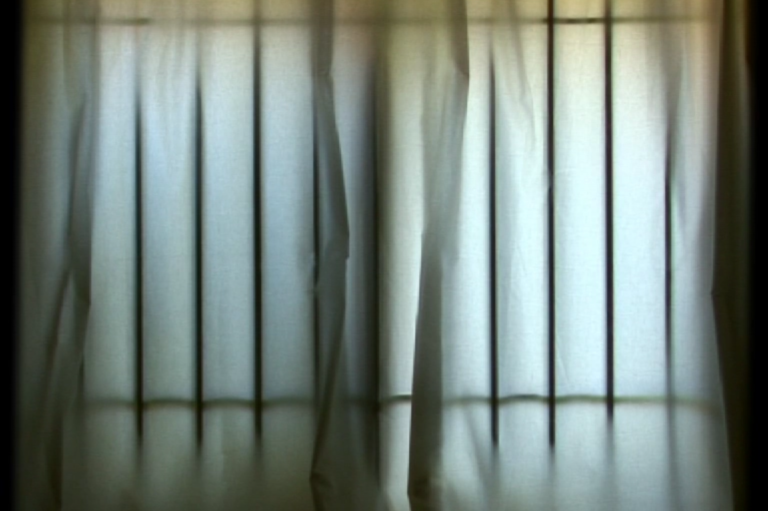
The Curtain (2007)
The Curtain *- video installation (video projection on canvas), HDV, color, mono, 22 min/loop, concept, camera: Anke Schäfer, co-production with the Bag Factory Artists Studios Johannesburg, South Africa 2007
At first, the video work "The Curtain" seems to be about domestic space. It appears serene and peaceful, but the viewer slowly becomes aware of the burglar bars, which suggest a threat to security and the fear of intrusion. Deep within this fear is a desire for change, for something to change, and for the domestic space to be liberated by unknown strangers to restore trust.
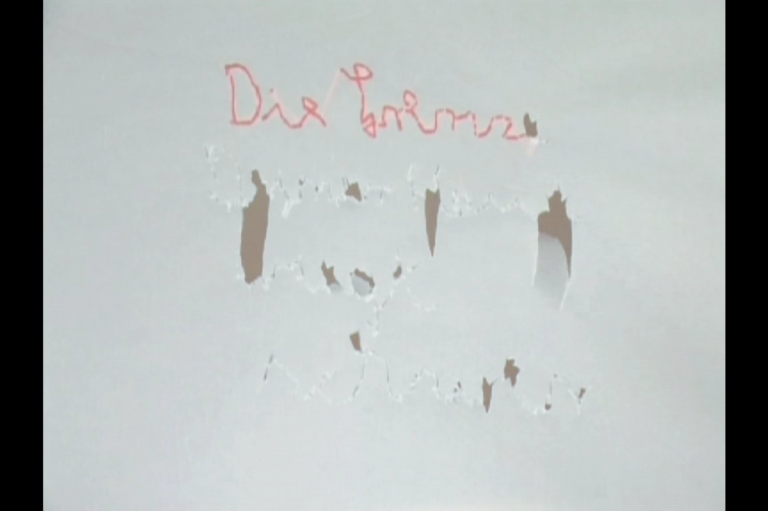
Die Grenze Deiner Haut… (2006)
Video installation with projection on transparent paper (loop), 4:00 min, HDV, 4:3, color, mono, ProRes file for screening
The German phrase DIE GRENZE DEINER HAUT WIEGT SCHWER is embroidered on a semi transparent canvas. After the last word, the weight of the needle tears the canvas, the thread comes loose and the words are erased. What remains in the torn canvas is an indecipherable pattern of the vanished message.
The apparent invulnerability of the electronic medium is presented as an insurmountable barrier to real communication.
The video DIE GRENZE proposes to transform the projection screen into a fragile surface, a vulnerable skin to be treated with tenderness.
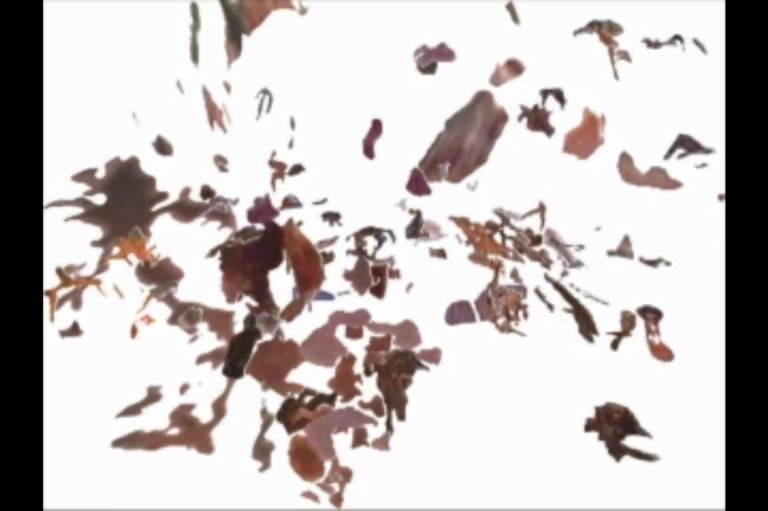
Testimony (2005)
Video for projection on cinema screen or as installation on canvas, HDV, 4:3, color, stereo, 2:00 min.. Concept, editing: Anke Schäfer, Maastricht / NL 2005
TESTIMONY is a cinematic, time-based painting that emerges from the wounds of various American anti-war, action, and Western films. In Testimony, the bloody traces of fictionalized violence do not disappear with the next cut or frame. Instead, they are highlighted as stigmata of fiction. As signifiers of real violence, they simultaneously fail to capture the insignificant horror of violence. These traces of violence are internalized and unfortunately breed moments of revival by polarizing politicians.
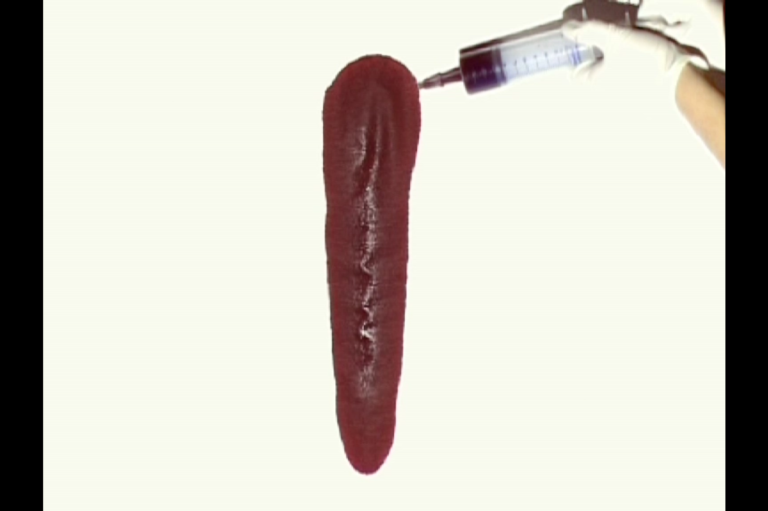
Test Signal (2005)
TEST SIGNAL – Video for projection on cinema screen or as installation on canvas, HDV, 4:3, color, stereo, 1:10 min.. Concept, performance, editing: Anke Schäfer, Maastricht / NL 2005
In the video work TEST SIGNAL, the color bar, which is typically used to test the quality of color representation in television pictures, is replaced by a large bloodstain. A hand wearing a rubber glove appears with a large syringe and sucks the "blood signal" from the screen. Instead of testing the technical quality of the image, TEST SIGNAL tests the projection screen as a carrier of an illusory physical reality, whose truths are as fleeting as the images that run across it. These images present unbearable acts of violence in a consumable form. The distinction between fiction and fact disappears in the precision of the color image. TEST SIGNAL measures the factual content of what is depicted.
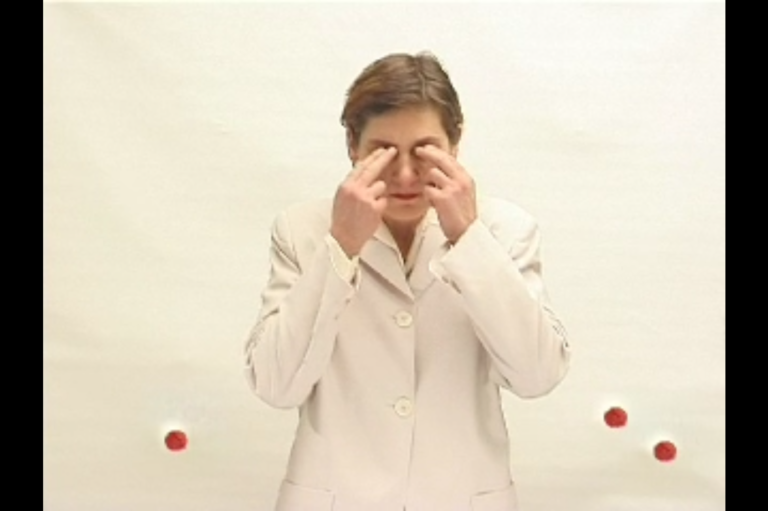
Wunden Wunder (2004)
Video for projection, video installation with projection on canvas (loop version) or single channel; HDV, color, mono, 4:3, 2:02 min., 2004
A performer repeatedly stabs her finger through the white costume she's wearing. Each time, a red spot—a wound—appears on the screen. The white projection screen resembles the host's white business suit. Both seem to be awaiting information that they should present. The absence of an omnipotent sender creates an opportunity to search for the wound as a stigma within the matter itself. The wound remains hidden in an imagination devoid of words.
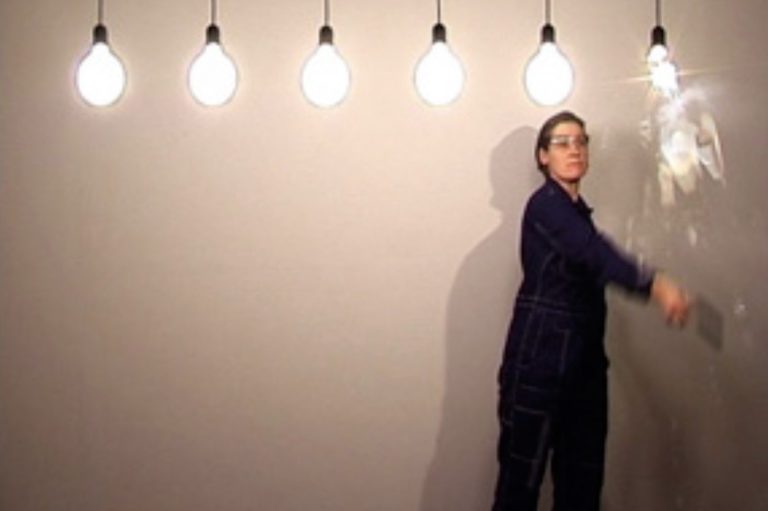
Reverse (2004)
Video for installation or single channel; HDV, color, mono, 4:3, 2:07 min., concept, shadow performance, editing: Anke Schäfer, camera: Desiree Palmen, production: Anke Schäfer NL 2001
Six hanging "globe" bulbs provide the light in this video. A woman wearing blue overalls with white seams smashes one bulb after the other. With the last bulb, she removes the light and her visibility, disappearing into the darkness. The white seams begin to fluoresce in the dark, but disappear when she walks away. The video "REVERSE" can be seen as a reverse Genesis of the desire for reproduction. In place of six days, there are six bulbs (type: "Globe"), and in place of a Sunday, there is darkness in which to relax and breed invisible images.
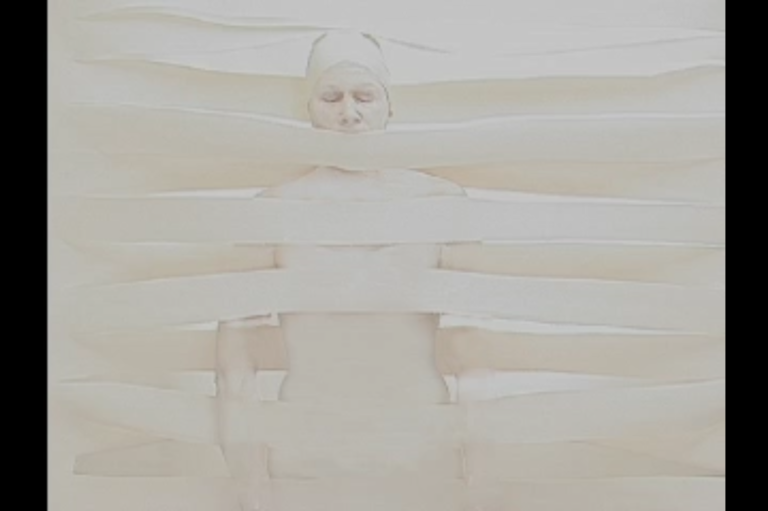
Undercover (2003)
Video for projection on canvas or single channel; HDV, color, mono, 4:3, 4:40 min., 2003
UNDERCOVER reflects the desire to physically merge with the projection screen while simultaneously becoming invisible through mimicry and bodily camouflage. The failure to go underground and disappear within the screen becomes the visible image itself.
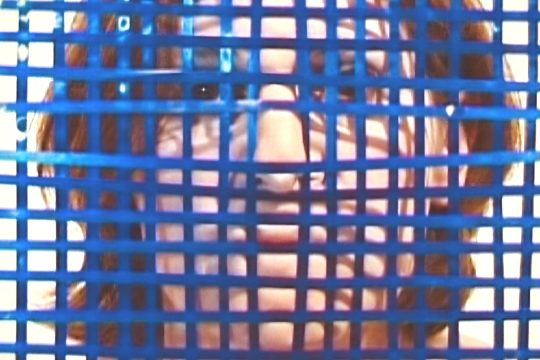
I Love You (2002)
Video for projection on canvas or paper or single channel; HDV, color, mono, 4:3, 1:52 min., 2002
A hand draws a grid with a blue pencil. Suddenly, a woman's face appears behind the lines, creating a space where, according to logic, there shouldn't be one. She presses her face against the grid. Then, as suddenly as she appeared, she disappears, leaving behind the flat image of the distorted blue grid. "I Love You" is about the longing for true closeness and contact, which often nestles in projection and illusion.
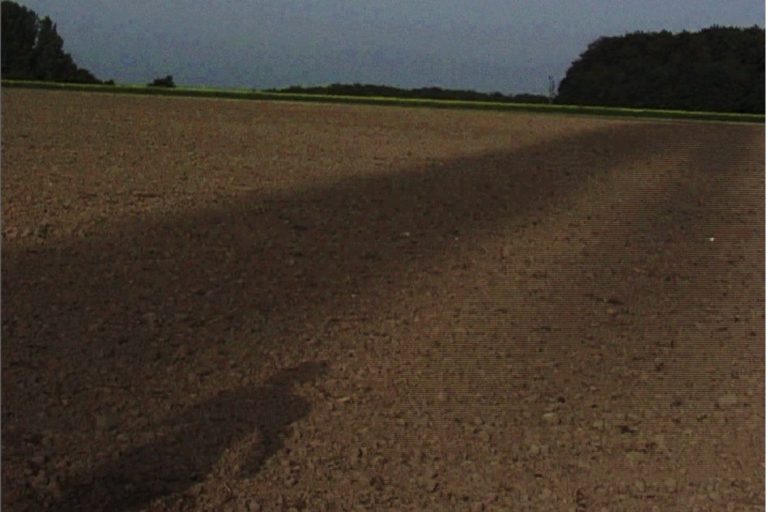
Depresso light (2001)
Video for installation or single channel; HDV, color, mono, 4:3, 1:00 min., concept, shadow performance, camera, editing: Anke Schäfer, co-production Anke Schäfer and Künstlerdorf Schöppingen, Germany 2001
Field strikes and windmill fights inspire the art of visual shadow boxing.
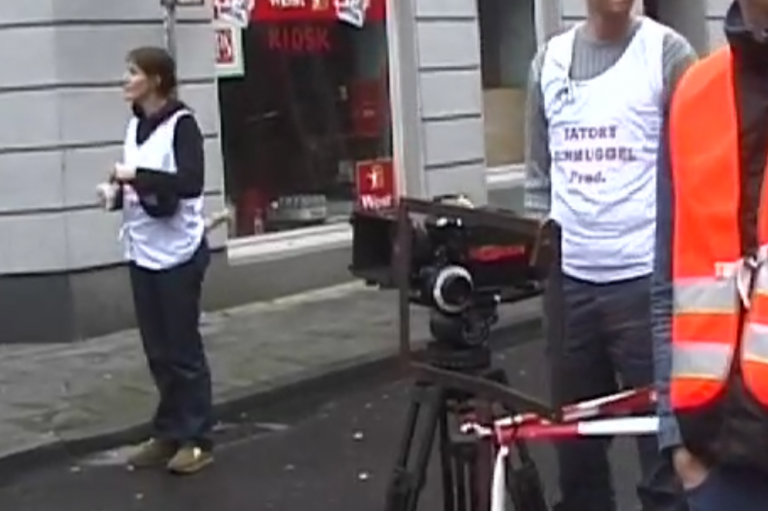
TATORT Schmuggel (2001)
HDV (original material: 16mm, DV), video for monitor or projection, color, stereo, 30:00 min., 16mm-camera: Jutta Tränkle, DV-camera: , co-production Anke Schäfer with Art foundation Stichting Smokkel Maastricht, NL 2001
TATORT documents the performative, site-specific film event of the same name, which took place on March 24, 2000, in Cologne as part of the art project SmokkelSchmuggelSmuggle. The filming took place on a street corner in Cologne where a "real" Tatort episode of the German TV series had been filmed. Guests were integrated into the film crew under the assumption that the filming would be used as a live art event to occupy public space while enjoying delicious food. Months later, their memories of the filming, collected in interviews, tell the story of what might have happened at the scene. The video Tatort is an experiment about memory, its gaps, and how they are used to construct one's own story.
Learn more about the art project SmokkelSchmuggelSmuggle 19992000 @ all works , publications, reviews
TAIG trailer - The Always Invited Guest Club (2000)
2000
more information will follow soon
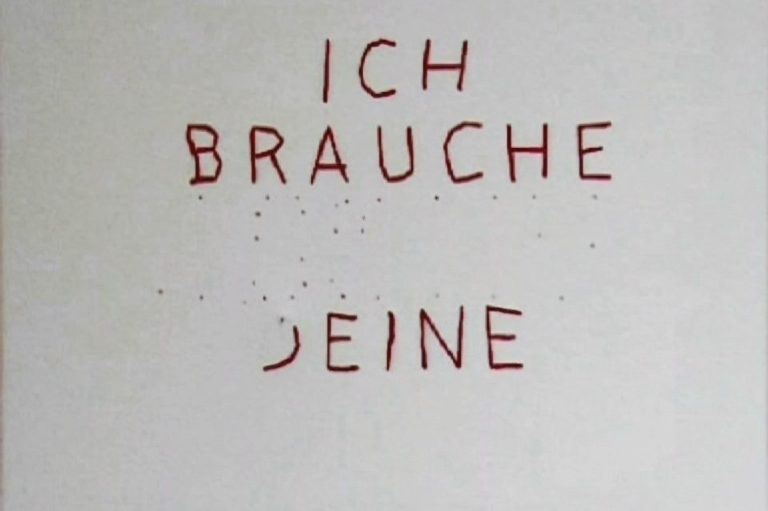
ICH BRAUCHE DEINE AUGEN (2000)
HDV - video for projection on canvas, single channel or installation/loop, color, 4:3, no sound, 20 sec., concept, production, camera, performance, editing: Anke Schäfer, NL 2000
ICH BRAUCHE DEINE AUGEN ("I need your eyes") appears as if sewn into the canvas from behind by an invisible needle guided by an invisible hand.
Between the two lines "ICH BRAUCHE" and "DEINE AUGEN" are the small, lost holes of an illegible word because the thread no longer exists. This is also the starting point of the video: an empty white screen with small holes in the middle. The viewer's desire for information meets the source of each visual message: I need your eyes. The desire to be seen and recognized is reflected in the text itself.
Exhibitions: “Tussen Huid en Orgasme” Brugge May 2005 (catalogue/ art book, edited by Roland Patteeuw, curator), Solo-Exhibition “BE WELCOME”, Dec. 2008/Jan. 2009, Kunsthalle Loppem, Lophem, Belgium. See more @ all works
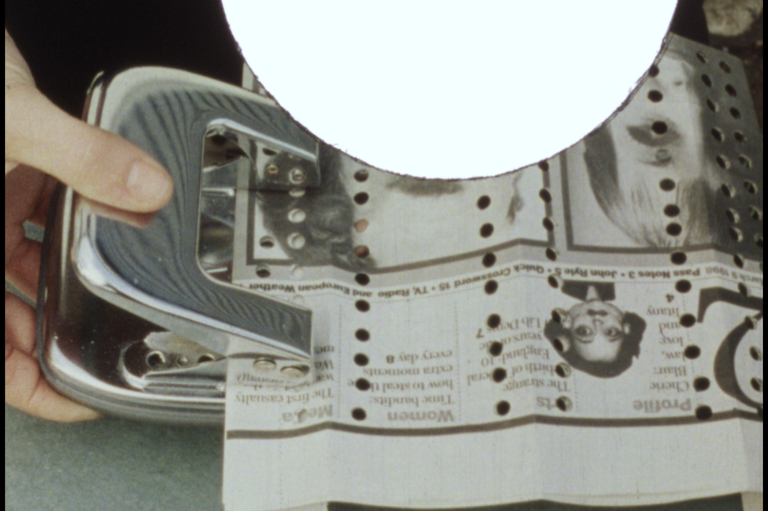
Uit de perforator van . . (1999)
UIT DE PERFORATOR (“From the punch”), 16mm, color, 6 min./loop, NL 1999; for 16mm film-installation with projection on a perforated wooden panel (acoustic panel) with hole diameter 8mm; distrbution and archiving: Eye Film Collection Amsterdam (since 2025)
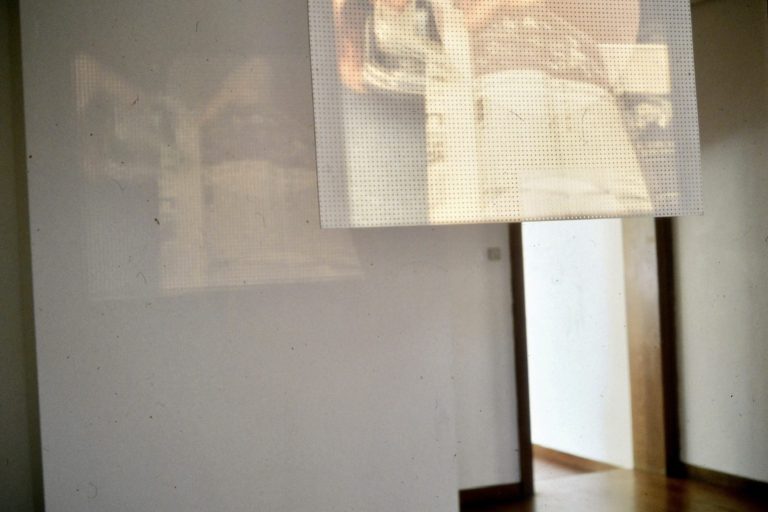
Uit de perforator van . . (1999)
UIT DE PERFORATOR (“From the punch”), 16mm, color, 6 min./loop, NL 1999; for 16mm film-installation with projection on a perforated wooden panel (acoustic panel) with hole diameter 8mm; first installation: Gemeentemuseum Hasselt 1999 solo exhibiton; distrbution and archiving: Eye Film Collection Amsterdam (since 2025)
“Uit de perforator” shows two hands folding and systematically punching a newspaper. The text 'A life for a life ... only if you are a woman' is briefly legible before the folding and punching continues. The 16mm film itself is also punched, irregularly erasing parts of the image without disturbing the regularity of our perception of someone punching a newspaper. The film is intended to be shown on a perforated white acoustic panel. Parts of the film fall through the holes in the screen. It seems that the image is doubled on the wall behind, for our perception there are still hands punching a newspaper, but the truth is that there must be two different images, the second that of the missing parts. “Uit de perforator" ("From the perforator") refers to our tendency to fill in what is not there and to ignore what we are punching out.
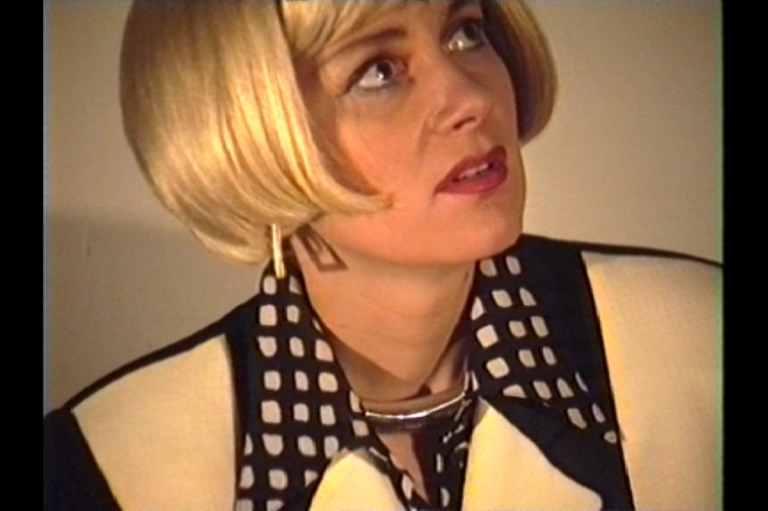
Jane Blond - Etüde Attitüden (1997)
Video for projection or monitor, HDV, color, mono, 3:30 min. Vienna 1997 (re-edit NL 2006), ProRes screening file, Video CD Art Edition; Performance, concept, camera, editing, production: Anke Schäfer, NL1997
In JANE BLOND - STUDY OF ATTITUDES, Anke Schäfer practises the character of her live movie star Jane Blond by trying out different attitudes in close-up: suggestive smiles as well as gestures of deep reflection and tender attention toward the viewer, whom she addresses directly. Some are yeses, some are nos, and Jane's remarks, "There's nothing beyond control" and "It's not true at all," transform the intimacy of this tête-à-tête into a strange feeling. They play with the viewer's expectations of how real she might be.
Exhibitions: “Sylvia Plaid & Jane Blond”, Kunsthalle Exnergasse Wien 1997; “HMY - PS1”, MoMA PS1 New York 1999; Frankfurt Art Fair, Galerie von der Milwe, Frankfurt 1999; Solo exhibition “BE WELCOME” Kunsthalle Loppem, Belgium 2008
Learn more @ presentations, publications, reviews
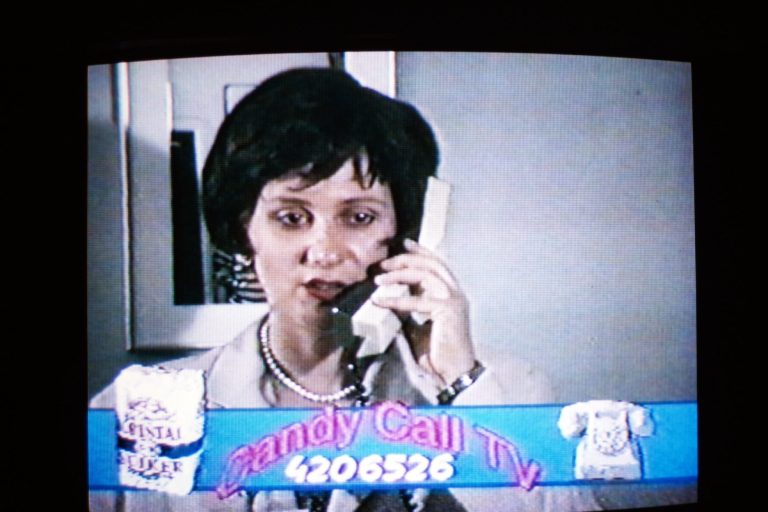
CANDY CALL TV trailer with Anna Key live (1996)
Video single channel, HDV, color, stereo, original 45:00 min., trailer for exhibitions and screenings: 14:00 min., live Candy TV-Performance: Anke Schäfer as Anna Key, NL1995
CANDY CALL TV *– video for TV, live on Amsterdam 1, art program “Almanac”, from 9 until 10 p.m, 24 June 1996
(original: 45 min. / doc.-demo: 8:50 min, / e-edited version CANDY CALL TV TRAILER: 14 min.)
CANDY CALL TV was almost an hour long and featured Anna Key talking about the power and beauty of Candy TV. Viewers were invited to call in and ask questions or order a Candy TV for their home. At the end, Anna Key gave a live demonstration by sugaring the TV screen 'from the inside'. - Candy TV stays on when you're zapping around. Candy TV maintains the value of your TV. Candy TV will survive the pixel of digital television...".
Learn more about Anna Key @ performances (see below), publications, reviews.
Anna Key - CANDY TV (1995)
Video for television, HDV, color, stereo, 3:00 min., Ned.1/KRO, Live on Netherlands 1 at prime time (8:30 p.m.), August 28, 1995, live Candy TV-Performance: Anke Schäfer as Anna Key, NL1995
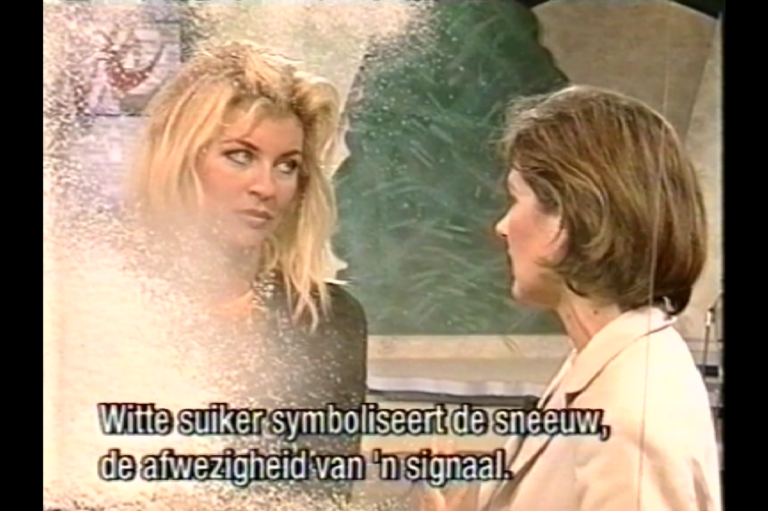
In Candy TV — Anna Key Live on TV, Anke Schäfer smuggled herself in as Anna Key to a primetime program on the broadcast channel Netherlands 1: the talk show Wie-o-wie. Invited by the broadcasting station KRO (Katholieke Radio Omroep), Anna Key appeared on August 28, 1995, and provided useful information about Candy TV for about three minutes. She demonstrated how to get a beautiful, white, sugary TV screen and enjoy "sweeter images than ever before." Anna Key demonstrated Candy TV's unique operating procedure live: "Candy TV works on the screen at home, close to private spaces."
This three-minute video shows the live performance, "Candy TV: Anna Key Live on TV," a performance project that I did undercover in the role of Anna Key. The video is a recording of the live performance that aired on Dutch television (Ned. 1) during the talk show Wie-o-Wie on August 28, 1995, at primetime.
The Dutch broadcaster KRO (Katholieke Radio Omroep) saw my Candy TV advertisement in the newspaper and called to ask if Anna Key would appear on their show. The deal was made on the understanding that Anna Key would be able to "sugar" the TV screen from the inside. During the interview, Anna Key explained the need for Candy TV and how everyone could enjoy "sweeter images than ever before" with a beautiful white sugared TV screen at home. She gave a live demonstration of her special DIY package and showed how Candy TV works "on the screen" rather than "behind the screen": "We give the power of TV to the people" (Anna Key in Wie-o-Wie, 1995). In 1997, Anke Schäfer was nominated for the Dutch Prix de Rome "Art & Public Space" with Candy TV.
Learn more @ presentations, publications, reviews
Kip Studie -Chicken Study (1995)
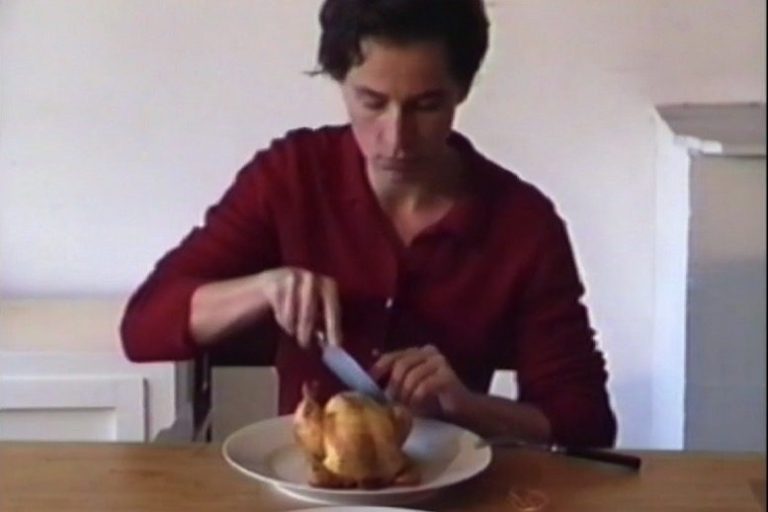
HDV, color, mono, format 4:3, 45:00 min., concept, director, camera: Anke Schäfer, protagonist: Desiree Palmen, NL1995
The “Chicken Study” was filmed in One-Take. The artist Desiree Palmen was asked to eat a French corn chicken in a way that was both gourmet and scientific: focusing on the two-dimensional reconstruction of the chicken skeleton on a second plate, and at the same time driven by the lust and desire to ingest, taste and swallow the chicken. - The protagonist was asked not to eat anything beforehand and was chosen for her ability to gnaw on the bones until there was hardly any meat left.
The gnawed bones were then used to reconstruct the skeleton of the French corn chicken in three dimensions and exhibited in the permanent collection of the Koenig Museum of Natural History in Bonn among the large skeletons of exotic birds, traces of the colonial past. (Exhibition "M.O. - Met Ondertitel", 1995; see catalogue/art book "M.O.")
Learn more @ presentations, publications, reviews
Den Mond Treffen (1995)
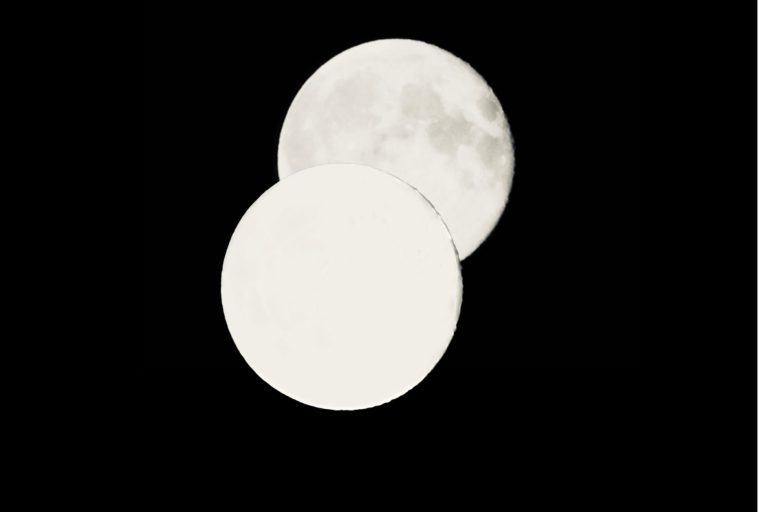
Super-8 Film, b/w, 3:03 min./loop; for Super-8 film-installation, Concept, camera, punching & editing, production: Anke Schäfer NL 1995
In “Den Mond treffen”, ‘Hitting the Moon’, two moons seem to come into contact. One is static, barely moving, while the other is dancing around the static one, almost provocatively. The dancing moon is actually a hole in the film material, punched several times into the 8 mm film with a 6 mm punch. The light from the projector falls through the hole and creates an image that resembles the filmed moon. The hole gives space to the light, the handmade plays with the unpredictable.
Learn more @ all works and reviews
Sweet TV (1994)
Video installation for monitor, ProRes digital file (Original: Hi-8), color, no sound, format 4:3, 10:00 min./loop., concept, performance, camera: Anke Schäfer, co-production with the Jan van Eyck Academy Maastricht, 1994
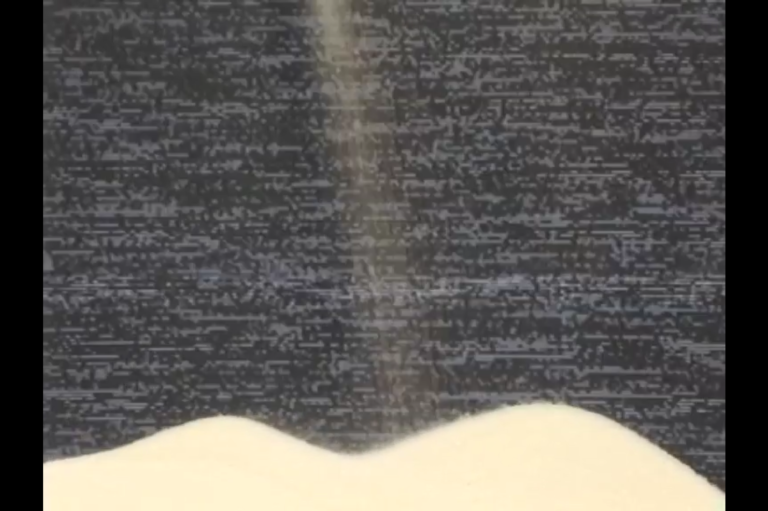
SWEET TV is not anti-TV, but rather the opposite: a monument to the white noise, the non-signal of TV, the moment before images are condensed, the insubstantial substance of not yet but possible.
In SWEET TV, white sugar slowly falls into the white noise of the so-called TV snow.
Over time, the sugar mounds grow, until finally all the TV snow disappears in a stable sugar coating. - The non-signal of TV is finally satisfied in its ultimately possible image.
SWEET TV is also part of the art installation work ‘SWEET TV Reliquary’.
Learn more @ presentations, publications, reviews
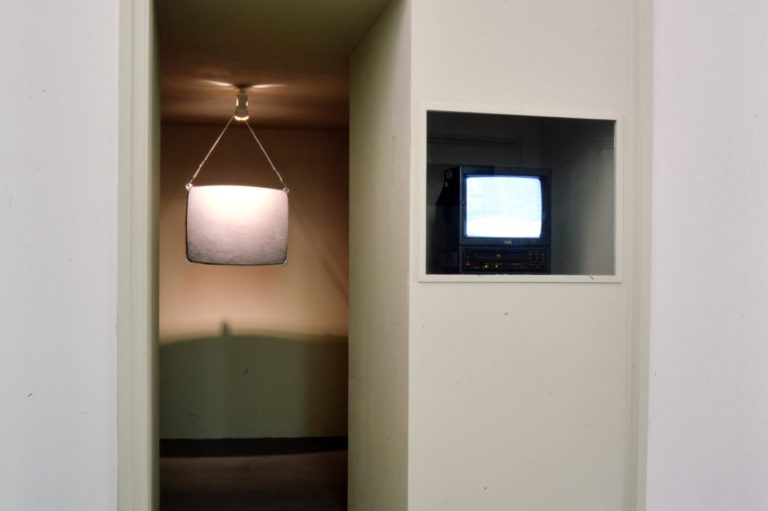
Sweet TV - installation (1994)
Video installation with video “Sweet TV”, sugared dead TV tube , vitrine and painted space; video: HDV, color, no sound, 10 min./loop., co-production with the Jan van Eyck Academy Maastricht, 1994
Installation view 1994: Jan van Eyck Academy Open Studios
SWEET TV Reliquary is an art installation featuring a Sweet TV video and a sugar-coated television tube in an intimate, museum-like space. The video plays on a loop.
This installation is a monument to television as a magical cultural object. Its magic can be fully experienced when the television is off-screen. The white, sugared screen of the picture tube, freed from its frame as a piece of furniture, condenses and depersonalizes this wondrous object into a special work of art.
The use of white sugar symbolizes the subliminal power behind image production, which has its roots in colonial exploitation strategies. These strategies fuel the desire for delicate and exclusive products to such an extent that they become mass products, creating and determining desires and longings.
Initially, sugar, like works of art and the production of cultural images, was as expensive as gold and produced exclusively for the rich and aristocracy. Today, it is an ubiquitous, addictive substance available to everyone. However, magic resists addiction and disempowerment. It invites us into the unknown, the off-screen world of disappearance.
Learn more @ presentations, publications, reviews

Kabelsteek - Cable Stitch (1994)
Installation with electricity cable, that was seemingly ‘stitched’ through the studio wall from the inside to the outside with two plugs, one of which was close to a socket
Co-production with the Jan van Eyck Academy Maastricht, 1994
Installation view 1994: Jan van Eyck Academy Open Studios
text & image will follow
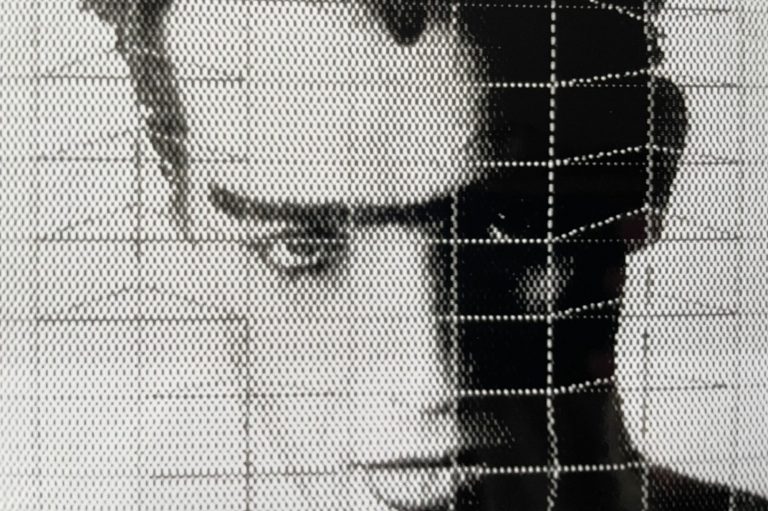
Supposed to thrill (1994)
Video installation with video “Sweet TV”, sugared dead TV tube , vitrine and painted space; video: HDV, color, no sound, 10 min./loop.
Installation view 1994: Jan van Eyck Academy Open Studios
Learn more @ presentations, publications, reviews
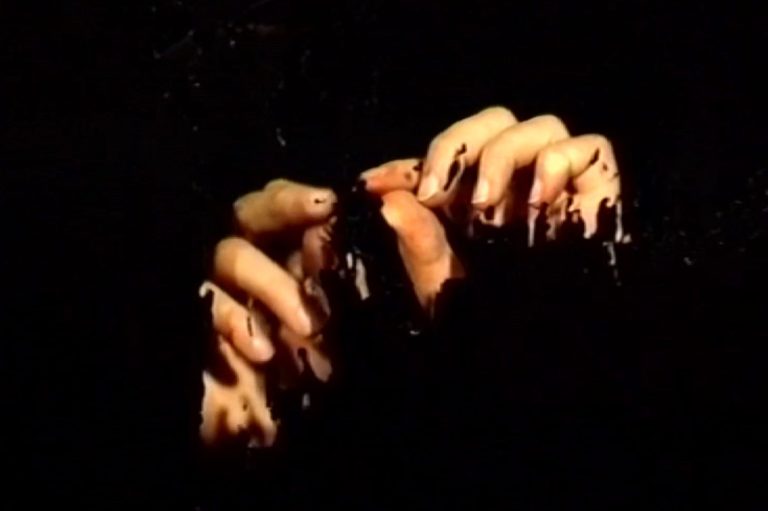
After Dark (1993)
Video for monitor or TV-screen, color, mono, 44:00 min./ loop (Orig. U-matic & Hi8, Jan van Eyck Academy Maastricht; U-matic tape lost; available: DV-copy & ProRes file), performer, set design, camera: Anke Schäfer, co-production: Anke Schäfer with the Jan van Eyck Academy Maastricht, NL 1993
The video ‘AFTER DARK’ is part of the "Glass Works" series. This series focuses on the physical reality of the screen. Suggesting real contact with the screen from the inside creates an intimacy with the medium. In contrast to the illusionistic closeness of distant events and stories, this intimacy exposes the actual closeness of the moment and the viewer, revealing the self-deceptive visual seductiveness of the medium.
In After Dark, someone scratches the black screen of the television, seemingly from the inside of the glass. The sound of the scratching nails is a lament for the futility of ever coming into contact with the real world. With each scratch, the fingers and arms doing the scratching become more visible. By the end, nearly all of the black has been scratched away, yet the performer dressed in black remains hidden in the darkness.
After Dark touches on the untouchable inner life of television as a medium by treating the dark screen as an ordinary windowpane. After Dark suggests that something might be hidden inside an inactive television. It is both a possible screensaver and a catalyst for the viewer's imagination..
Learn more @ presentations, publications, reviews
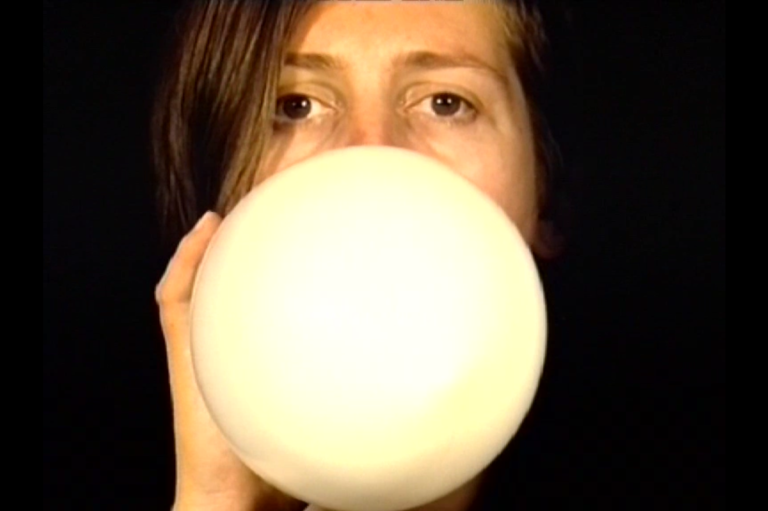
Blow Up (1992)
Video for monitor or TV-screen, color, mono, 44:00 min./ loop (Orig. U-matic & Hi8, Jan van Eyck Academy Maastricht; U-matic tape lost; available: DV-copy & ProRes file), performer, set design, camera: Anke Schäfer, co-production: Anke Schäfer with the Jan van Eyck Academy Maastricht, NL 1992
The video "Blow Up" is part of the "Glass Works" series. This series focuses on the physical reality of the screen. Suggesting real contact with the screen from the inside creates an intimacy with the medium. In contrast to the illusionistic closeness of distant events and stories, this intimacy exposes the actual closeness of the moment and the viewer, revealing the self-deceptive visual seductiveness of the medium.
Learn more @ presentations, publications, reviews
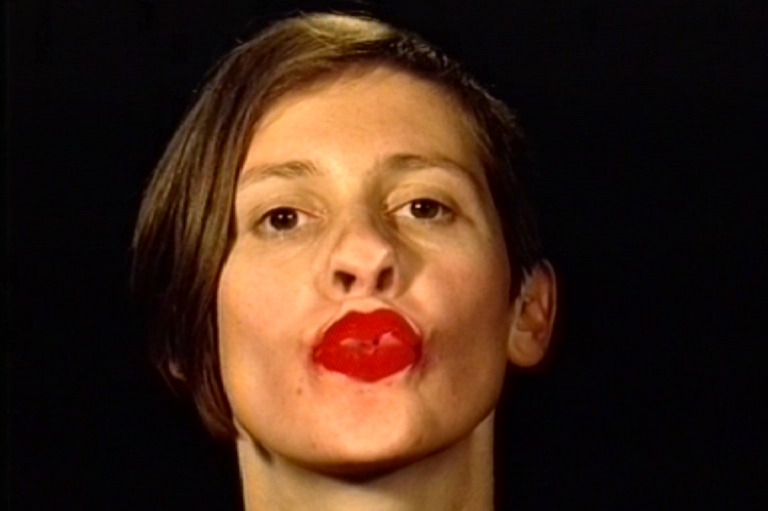
Kisses (1992)
Video for monitor or TV-screen, color, mono, 44:00 min./ loop (Orig. U-matic & Hi8, Jan van Eyck Academy Maastricht; U-matic tape lost; available: DV-copy & ProRes file), performer, set design, camera: Anke Schäfer, co-production: Anke Schäfer with the Jan van Eyck Academy Maastricht, NL 1992
The video "Kisses" is part of the "Glass Works" series. This series focuses on the physical reality of the screen. Suggesting real contact with the screen from the inside creates an intimacy with the medium. In contrast to the illusionistic closeness of distant events and stories, this intimacy exposes the actual closeness of the moment and the viewer, revealing the self-deceptive visual seductiveness of the medium.
In "Kisses," a woman kisses and licks the monitor's glass from the inside in an impossible search for contact. This leaves a mark on the boundary between inside and outside, transforming the intimate viewing experience into one of rupture and confusion.
Learn more @ presentations, publications, reviews
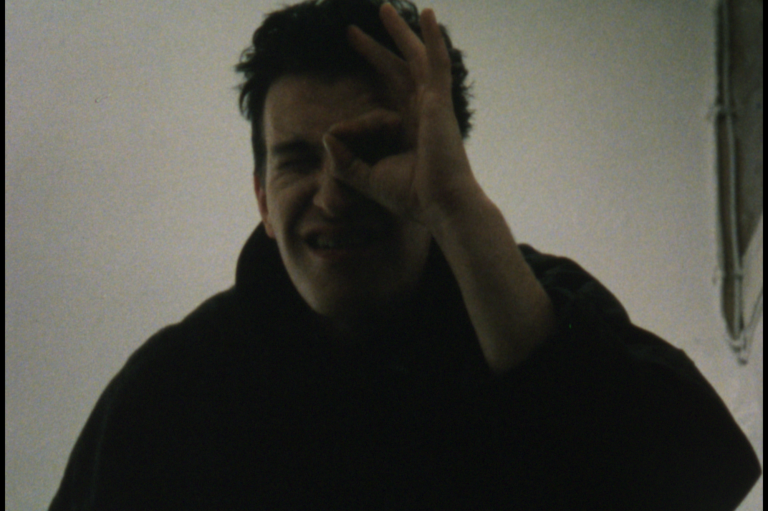
Eine Kuh muht nicht umsonst (1990)
16mm short film, color, stereo, 4:3, script, concept, director, editor: Anke Schäfer, performer: Gerwin Kothen, Ina van Dreusche, camera: Georg Fick, camera assistant: Albert Liesegang, sound: Jens Ruhnau, lighting designer: Thomas Janssen, assistance: Gerda Van San, photography: Edda Siever, photo retouching: Deliah Bensch, make-up artist: Sabine Ulrich, production: Anke Schäfer, Germany 1990
Supported by Filmhaus Köln & WDR Köln
Distribution original 16mm screening copy and ProRes file: Eye Film Collection (since 2025)
Digital file (different formats): contact Anke Schäfer
Learn more @ presentations
see also at “Film Works”
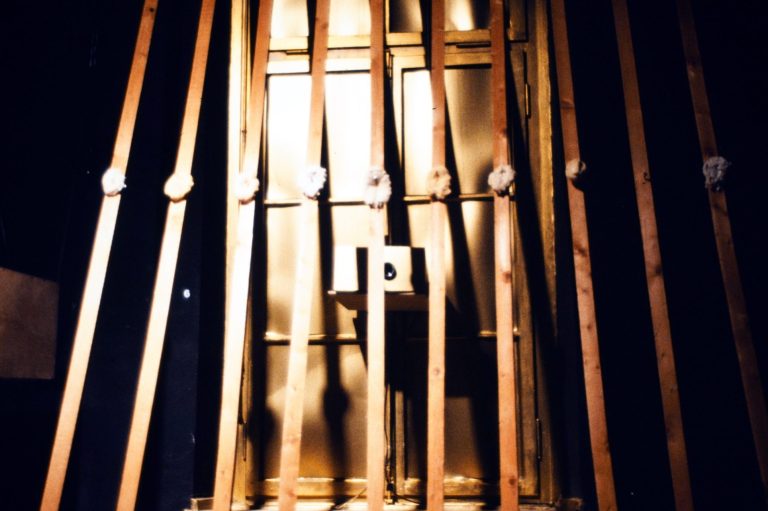
PERFORMANCE & THEATRE WORK
Performance pieces in and around the TAM Theatre in Krefeld, in the public space of San Francisco, selected tourist places of Vienna, at a former shooting location of the German TV “Tatort” serie in Cologne.
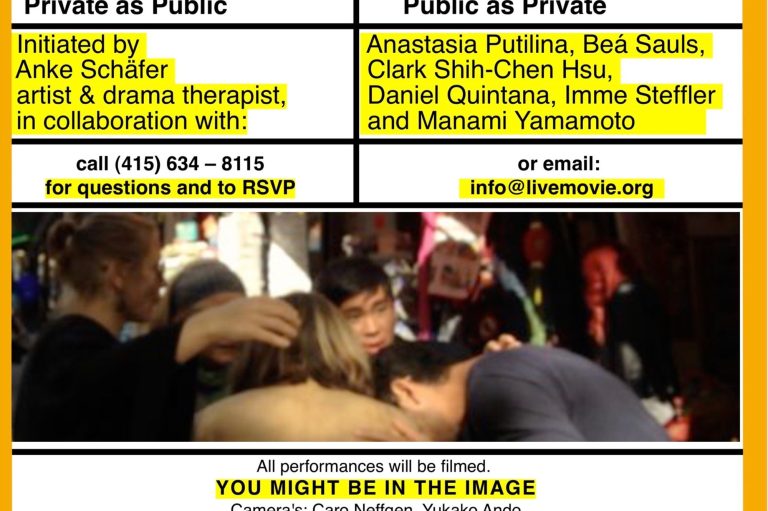
NOW HERE (2014)
Eight-hour performance at five sites in San Francisco with colonial and police violence connotations on December 3, 2014.
During the performance, a small group of performers led visitors to five different locations throughout San Francisco. These locations held biographical significance for some of the performers and contained visible and invisible traces of violence experienced through generations.
The performers had previously participated in an eight-session drama therapy workshop on embodied transgenerational legacies led by Anke Schäfer. They researched possible embodied traces of violence or disintegration through embodied sculptures and scenic improvisation.
See documentation eponymous video essay “Now Here” (2014).
Jane Blond - A Live Movie Star (1997 - 1999 - …)
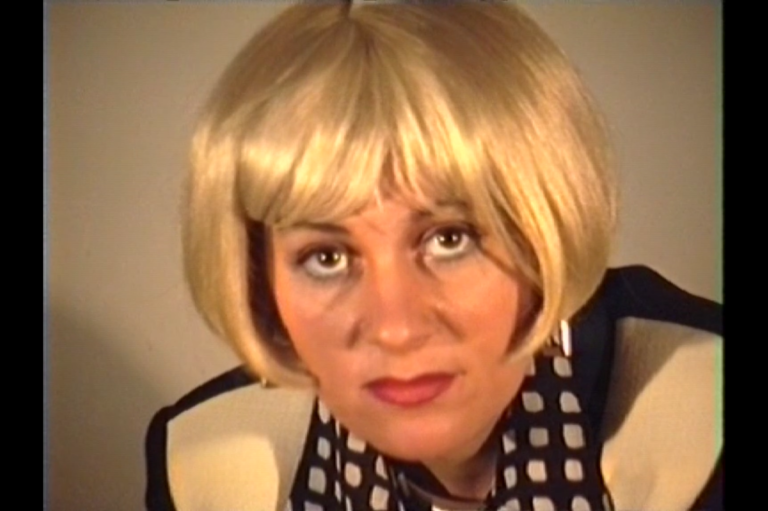
JANE BLOND was a performative project in a semi-public space in Vienna during her six-month artist-in-residence program in 1997, provided by the Austrian Ministry of Culture.
The publication Jane Blond & Sylvia Plaid: Special Guests in Vienna documents unannounced interventions at various locations through the writings and notes of invited witnesses, including the Dutch art historian and curator Mique Eggermont; the artist Hans Poschauko; the writer Judith Fischer; the art critic Patricia Grzonka; and others.
In 1999, Jeanne van Heeswijk invited Jane Blond as a special guest for her "HNY - PS1" project in New York.
For the P.S.1 project, Jane auditioned in an exact replica of a room from the legendary Rotterdam Hotel New York. The auditions were broadcast live in black and white to the waiting room outside. Jane chose one of the candidates, a young male student, to appear in a "live film" performed on the top level of the Chrysler Building. There, she brought his fantasy of buying a large space in the building to life.
The concept of "Jane Blond: A Live Movie Star" was to test fantasies of wealth in real life and make them come true, if only for a few minutes. No filming was allowed as it would have interfered with the live experience, undermining the concept of a "live movie," where life and performance are not separate.
The auditions for the P.S. 1 New York project are documented in the artist's book HNY - PS1, edited by Jeanne van Heeswijk.
Learn more at Publications, All Works, and Reviews.
See also the video work: “Jane Blond - Etüde Attitüden”
Anna Key & Candy Call TV (since 1995)
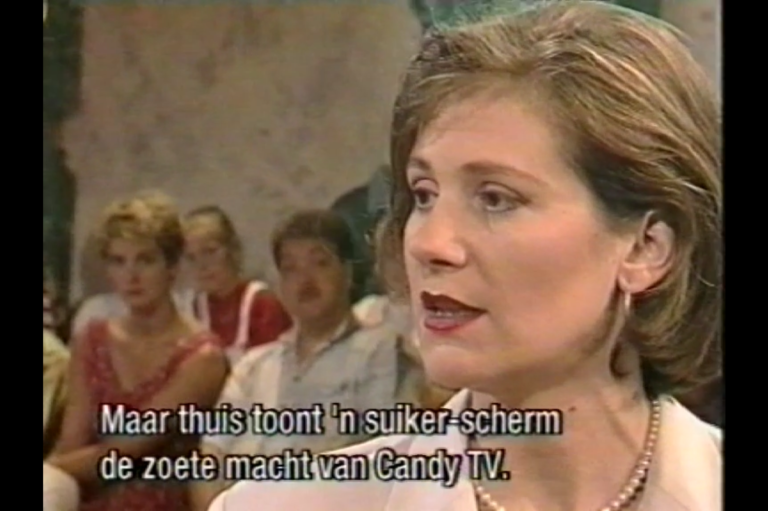
Anna Key is an artistic figure created by Anke Schäfer who acts in real life (like Jane Blond, Anke's other artistic figure).
Anna Key intervenes in the public media to promote the sugaring of the TV screen, both from inside during TV programmes and from outside on the TV screens of interested customers.
In 1996, a Candy TV Shop was set up in Maastricht during the Christmas period, and at the invitation of the Kunstverein Aachen, the so-called "Kabinett des Kunstvereins" was also transformed into a Candy TV Shop.
There were several live performances by Anna Key to promote Candy TV, e.g. during an event at W139 in Amsterdam in 1998 and in 1999 during the exhibition "schnittstelle/produktion" at Shedhalle Zurich, curated by Yvonne Volkart & Uli Kremeier:
http://archiv2009.shedhalle.ch/dt/archiv/1998/ausstellung/produktion/produktiondt.shtml
At this occasion also a Candy TV-DIY-manual was published. An adapted re-edited version of this Do-It-Yourself manual is since October 2024 available at the Instagram account @ankeschaefer.here
Learn more @ presentations, publications, reviews
Oper für N. (1990)
(Opera for N)
After a draft for an opera by Tzie M. Elgna (pseudonym of a renowned contemporary composer); realized in commission of the TAM Theater Krefeld;
Performers: Gerda Van San, Pit Therre (Tenor and pianist); Composition for singer at piano, choreography, set design, director: Anke Schäfer
Learn more @ all works and reviews
Gi-Oh-Tine (1989)
Visual Composition with six scaffolds and performers in commisson of the festival “Frauen setzen Zeichen”, Cologne
Performers: Gerda Van San, Heidi …
Concept, script, choreography, set design, director: Anke Schäfer
Learn more @ all works and reviews